← Back to portfolio
03 Platform Teardown Self-initiated
Reviving Facebook

A CPR Protocol

By Donna Louissaint

A CPR protocol for Facebook.

If you were asked to build a movie product for Facebook, what would you do? My answer wasn't a feature. It was a complete teardown of the platform.

A platform that needs CPR.

I don't use Facebook anymore. That's not an attack. That's a data point.

For years, it was the center of my social world. Now, like for so many people in my generation, it feels like a relic. The feed is a chaotic mix of distant relatives, intrusive ads, and memories from a life I no longer live.

The platform feels like it needs CPR. It's trying to be everything. A marketplace. A gaming hub. A news source. A dating app. In doing so, it has lost its soul.
The Drift

A platform built for 2010.

Year Facebook launched

2004

Built to connect people
you already knew

Year the model peaked

2010

When the news feed
was still relevant

People are drowning in shallow connections and starving for deep, interest-based community. We don't want to keep up with old friends. We want to find our new tribe.

Kill the feed. Build the hub.

My solution is not to add another layer to a broken model. It is to perform a strategic demolition and rebuild Facebook from the ground up around its single most valuable, yet underutilized, asset: Groups.

We will kill the traditional News Feed. It is dead.

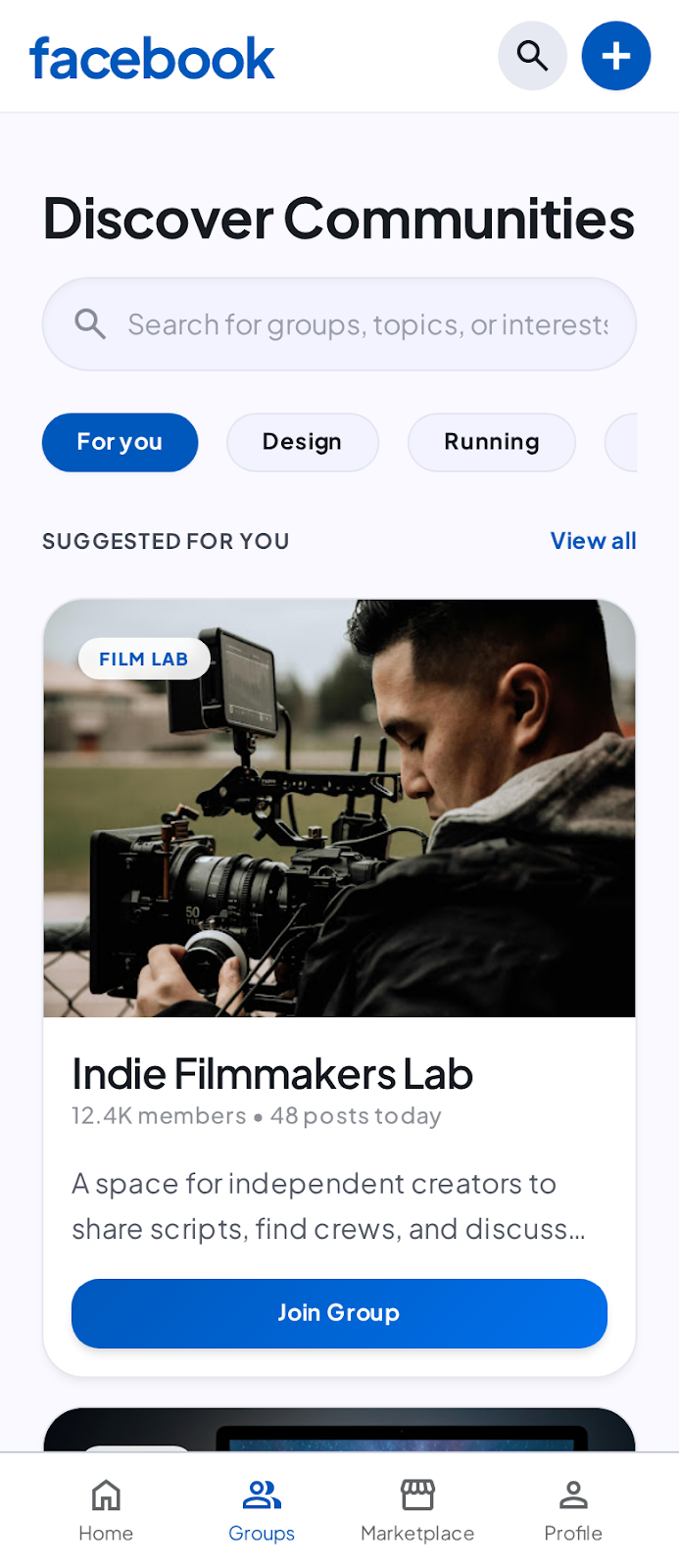
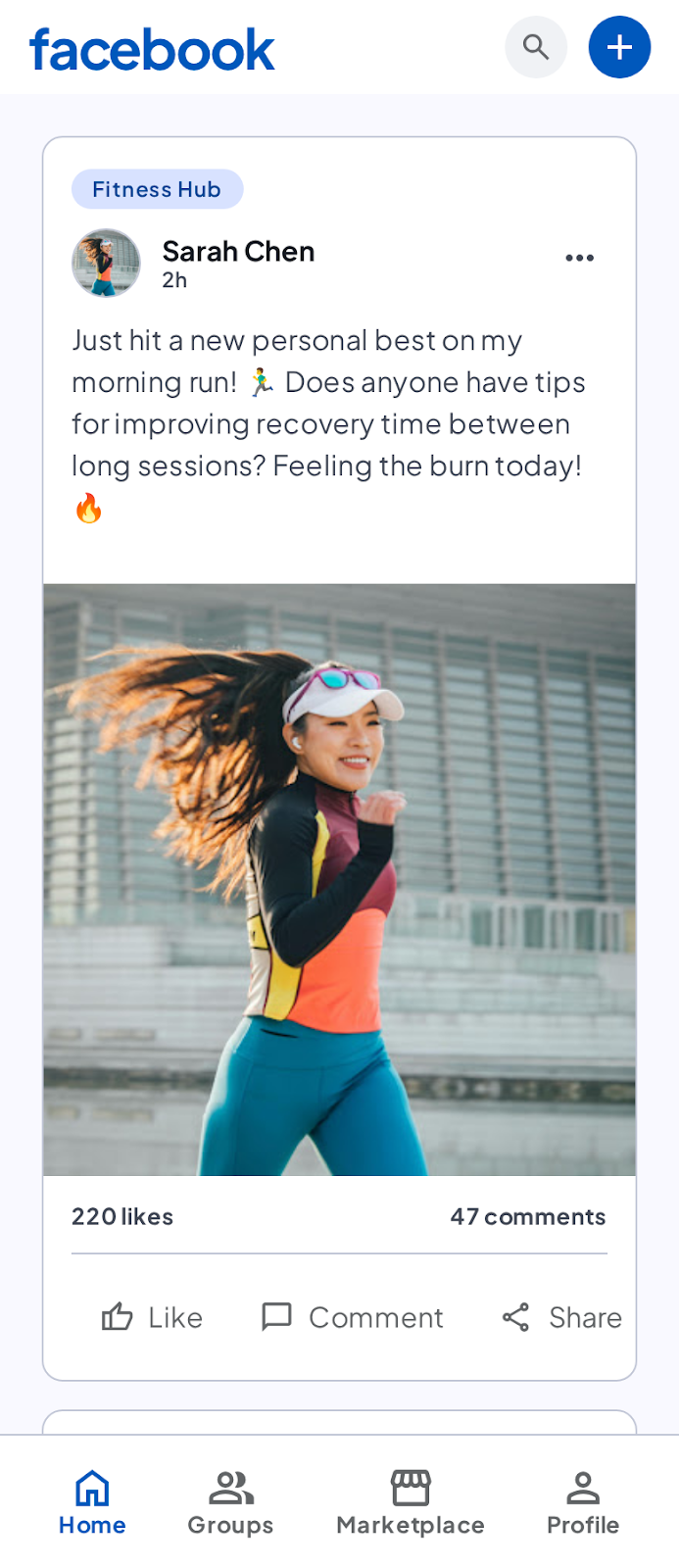
The new Facebook will be a Groups-First platform. A discovery engine for communities. When a user opens the app, they will not see what their aunt posted. They will see a vibrant, personalized feed of content from the interest-based groups they have joined. Their hubs.

The Old Facebook

A passive social archive.

The UX designer trying to break into the industry logs on to see high school photos. The filmmaker logs on to see political arguments. A digital scrapbook of a life they no longer live.

The New Facebook

An active utility.

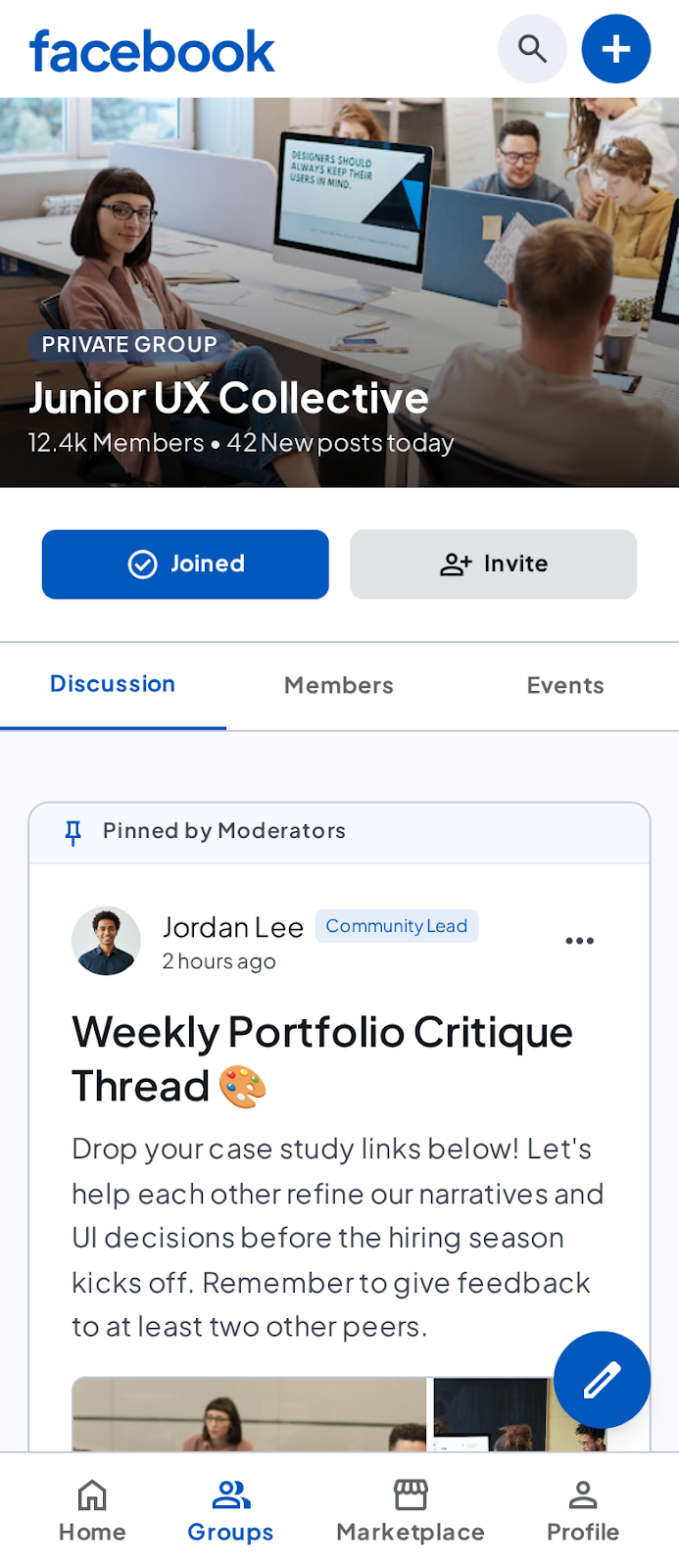
The UX designer logs on to see the latest discussion in her "Junior UX Collective" group. The filmmaker logs on to get feedback on her script from the "Indie Filmmakers Lab" group. A launchpad for what's next.

The Reframe

This pivot transforms Facebook from a passive social archive into an active utility for personal and professional growth. It makes the platform essential again.

Groups-first home feed

01 — Groups-first feed

Inside a group

02 — Inside a group

Discover communities

03 — Discover communities

Concept  Groups-first feed — posts from your tribe, not your high school class

Answering the original question.

Back to the original prompt. How would I build a movie product for Facebook?

I wouldn't. Not as a standalone feature. That would be another bolt-on distraction. Instead, the movie experience becomes a natural extension of the new Groups-first ecosystem. We empower the community.

01 — Filmmaker Groups

Hubs for collaboration.

Members share scripts, post casting calls, get feedback on rough cuts, and host live Q&A sessions with directors using a built-in live-streaming feature. The work happens here.

02 — Cinephile Groups

Engines for discovery.

A group dedicated to "Classic French Cinema" curates watchlists, hosts virtual watch parties, and facilitates deep discussions. The community is the algorithm.

The product isn't the film. It's the vibrant conversation, connection, and creation happening around the film within these dedicated groups.

Marketplace and Gaming, solved.

This Groups-First model elegantly solves Facebook's other identity crises.

Marketplace

From garage sale to curated trust.

Stops being a chaotic, untrustworthy garage sale. Becomes a series of curated, interest-based marketplaces. The "Vintage Camera Enthusiasts" group has its own marketplace for trusted members. The "Mid-Century Modern Furniture" group becomes the best place online to find a specific Eames chair.

Gaming

A direct shot at Discord.

Each gaming group gets its own built-in voice channels, streaming tools, and event calendars. Facebook stops being where you happen to share game clips and becomes where you actually game with people.

Why this isn't just better. It's bigger.

This isn't just about making the platform feel better. It's about building a stronger business.

By focusing on deep, interest-based engagement, you dramatically increase time spent on platform and daily active users. The two metrics that drive ad revenue.

The advertising goldmine

This model fundamentally upgrades Facebook's ad business. Instead of targeting users based on broad demographics and inferred interests, advertisers reach hyper-specific, high-intent communities.

A company selling high-end camera lenses can advertise directly within the "Vintage Camera Enthusiasts" group. This level of contextual relevance makes the ads more valuable to the user and exponentially more effective for the advertiser. Facebook can command a premium price for its ad inventory.

New KPIs

Stop measuring likes.

01 — KPI

Group Creation & Membership Growth

The pulse of the new platform. How quickly are new tribes forming?

02 — KPI

Engagement Rate Within Groups

Comments, posts, live views, depth of participation. Not vanity metrics.

03 — KPI

User Retention by Group Activity

The number of active groups a user belongs to becomes the strongest predictor of long-term retention.

The Shift

We stop measuring "likes" on a photo. We start measuring whether a community is alive. Because that's the only metric that compounds.

Facebook doesn't need another feature.
It needs a new purpose.

It needs to stop trying to be a digital scrapbook of our past and start being a launchpad for our future. By re-architecting the entire platform around the human need for community, connection, and growth, Facebook can be revived. It can stop being a place we visit out of obligation and become a place we can't imagine living without.

Donna Louissaint · Brand & Product Strategist

Next Case Study · 02 / 03

Square 2.0

Turning Square from a transaction tool into a lifelong business partner.

Read the case study